
16-6-2026
The Dutch residential property investment climate will get a boost from the Dutch government in the September budget, visitors to the Provada real estate fair in Amsterdam were told last week.
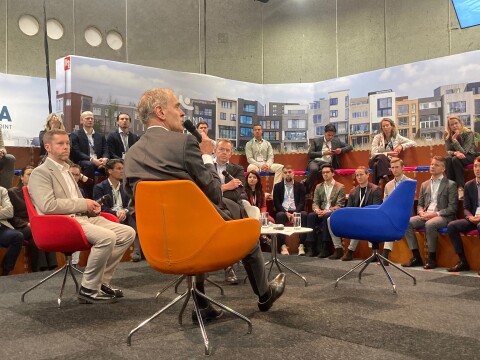
CBRE's David Inskip, APG's Robert-Jan Foortse and Bouwinvest's Mark Siezen during the panel discussion. Photo: Robin Pascoe
Real estate investors and developers in the Netherlands have repeatedly called on the Dutch government to create a stable investment climate for foreign capital, which they say is essential to beat the shortage of rental housing.
And now, said Mark Siezen, chief executive of Bouwinvest, he is positive new measures will be announced in September when the housing ministry publishes its annual spending plans.
"There is a clear realisation that things need to change," Siezen told a panel during International Investors Day at Provada. "I have a good feeling about September."
Level playing field for pension funds
The main problem, Siezen said, is that foreign pension funds are not able to benefit from the same tax regime as Dutch ones, which are exempt from 25% corporation tax. "We need to create a level playing field," he said, adding that a change would be easy to implement. The Dutch tax office is currently assessing the likely impact of such a move, following a vote in favour in parliament.
In addition, cutting the property transfer tax rate - currently 8% - would also be a quick win, Siezen said. That tax rate has already been reduced from 10.5% and a further cut to 7% is planned for next year.
The government has set a target of building 100,000 new homes a year but, Dutch investors warn, without international investors, it will be impossible to meet the goal.
Housing policy too complex
Robert-Jan Foortse, head of European property investments at pension investment company APG, told the same Provada panel the Dutch economy was in good shape but that current housing policy made it "too difficult" for investors.
"They've not stopped investing in residential property," he said. "They just don't invest in the Netherlands any more."
Between 2018 and 2022, foreign investors were responsible for funding some 4,700 homes a year in the Netherlands but this has now dropped to around 500, according to new research by Capital Value.
Successive Dutch governments have all tinkered with housing policy, making it impossible for foreign investors such as pension funds to gain the stability they need to make long-term investments, Foortse said.
Good news ahead
Trust and consistency, he said, are crucial to bringing back long-term participation. "Being slightly attractive," he said, "is not enough." He, too, said he was "confident" that the sector would get "good news" before the budget.
In December last year, five housing lobby groups - including investors, housing corporations and landlords - published a seven-point plan to improve the investment climate.
As well as bringing in equal tax rules for pension funds and several tax changes, they want to allow social housing providers to be able to make use of state aid, abolish the corporation tax on social housing and re-evaluate the rent regulation rules for mid-market properties.
Minister recognises change is needed
Dutch housing minister Elanor Boekholt-O'Sullivan has already outlined several changes to current affordable housing legislation that she hopes will encourage more private landlords to offer rental properties in the Netherlands.
"A mature mid-market sector is essential for a healthy housing market," the minister told MPs in a series of briefings and reports in May. "To ensure sufficient supply, it needs to be attractive enough to invest in, and that is often not the case at the moment."